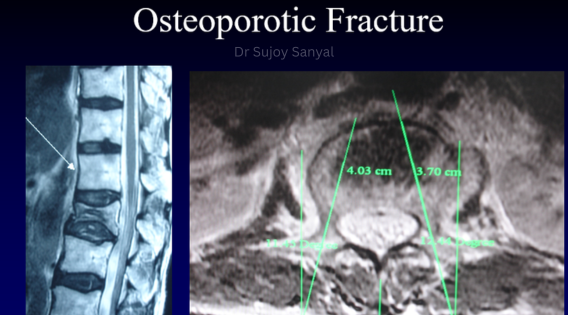
Spinal fractures may result from trauma (accidents, falls or sports injuries) or from osteoporosis (deterioration of bone tissue). Osteoporosis can make the vertebrae of older adults more fragile. Even a minor fall can sometimes cause a compression fracture. Treatment will vary depending on how badly the fracture is broken, the amount of pain, the stability of the spine, neurological symptoms and health. Some patients benefit from medication, activity changes, bracing, and physiotherapy. Others may need a minimally invasive procedure. Dr Sujoy Sanyal, The Top Spine Surgeon, provides expert care to patients after osteoporotic spine fracture treatment in India and provides relief from pain and spinal instability.
A vertebral compression fracture is a fracture where the bone in the spine collapses. These fractures are seen in the thoracic or lumbar spine.
One of the important risk factors is osteoporosis, especially in older people. They may feel a sudden onset of back pain, become unable to stand up straight or walk, have less mobility or feel more pain when they move. X-rays, CT scans or MRIs may be used to evaluate the fracture and to see if it has damaged other parts of the body. Bones in the spine are prone to fracture. The bones in the spine can easily get fractured.
Spine fracture treatment in Kolkata will vary from case to case. The first step is to assess the stability of the fracture and the pressure on the spinal cord and nerves. Conservative treatment options are pain management, rest for a short time, bracing, and supervised rehabilitation. It's also important that treatment for underlying osteoporosis is considered – as this can help to prevent future fractures.
Some minimally invasive procedures may be recommended for cases of severe pain that persist despite conservative treatment.
Vertebroplasty is a procedure that injects medical bone cement into a broken vertebra. The cement will set in the bone and may provide support for the broken vertebra. The technique involves placing the needle in the correct position with some form of imaging. It is considered for some painful compression fractures. The decision is based on various criteria, including fracture age, imaging results, symptoms, and general health.
For certain cases of vertebral compression fractures, another minimally invasive procedure called Kyphoplasty may be performed. It typically involves a small balloon being inflated in the compressed vertebra prior to bone cement injection. The balloon might be used to make room for cement to be placed and can help restore some height to the vertebra in some patients. Results are, however, different from patient to patient. Not all fractures can be treated with kyphoplasty.
There is a significant difference between Vertebroplasty vs Kyphoplasty: the procedure that takes place prior to the injection of the cement. In the case of a vertebroplasty, a direct injection of cement is performed in the affected vertebra. Before the cement is put in, it's typically performed with a balloon in Kyphoplasty. Neither procedure is necessarily better for all patients. It is determined by the fracture pattern, symptomology, imaging, and treatment goals.
The Vertebroplasty and Kyphoplasty recovery time in the elderly patients is just a few days of hospital stay. Recovery will depend on your age, overall health, fracture type, your ability to move and other medical issues. A relatively small number of patients benefit from pain improvement shortly after treatment. Others may need further rehab to be able to resume normal activities.
Older people may also require fall prevention advice and treatment for osteoporosis. These measures are crucial as the treatment of one fracture does not eliminate the risk of another fracture.
The spine surgeon uses advanced imaging guidance to ensure maximum Vertebroplasty and Kyphoplasty safety in the elderly patients. The practice may be risky. Complications may include infection, bleeding, leakage of the cement, nerve-related complications, or other complications from the procedure. Personal risk is dependent on the patient's health state and fracture characteristics. Pre-treatment evaluation by a specialist for medications, medical conditions, imaging, and fracture history is recommended.
If a person continues to have pain or mobility is reduced after a fracture, it should not be ignored. Early evaluation can help determine the fracture and help direct the proper treatment. Dr Sujoy Sanyal can evaluate the spinal problems and discuss the options of treatment with the patient in accordance with their requirements.
This is not the case and depends on the diagnosis, rather than the procedure being the same for everyone. Patients should discuss what they expect to gain from treatment, any risks involved, alternative options to treatment and rehabilitation needs prior to treatment.
